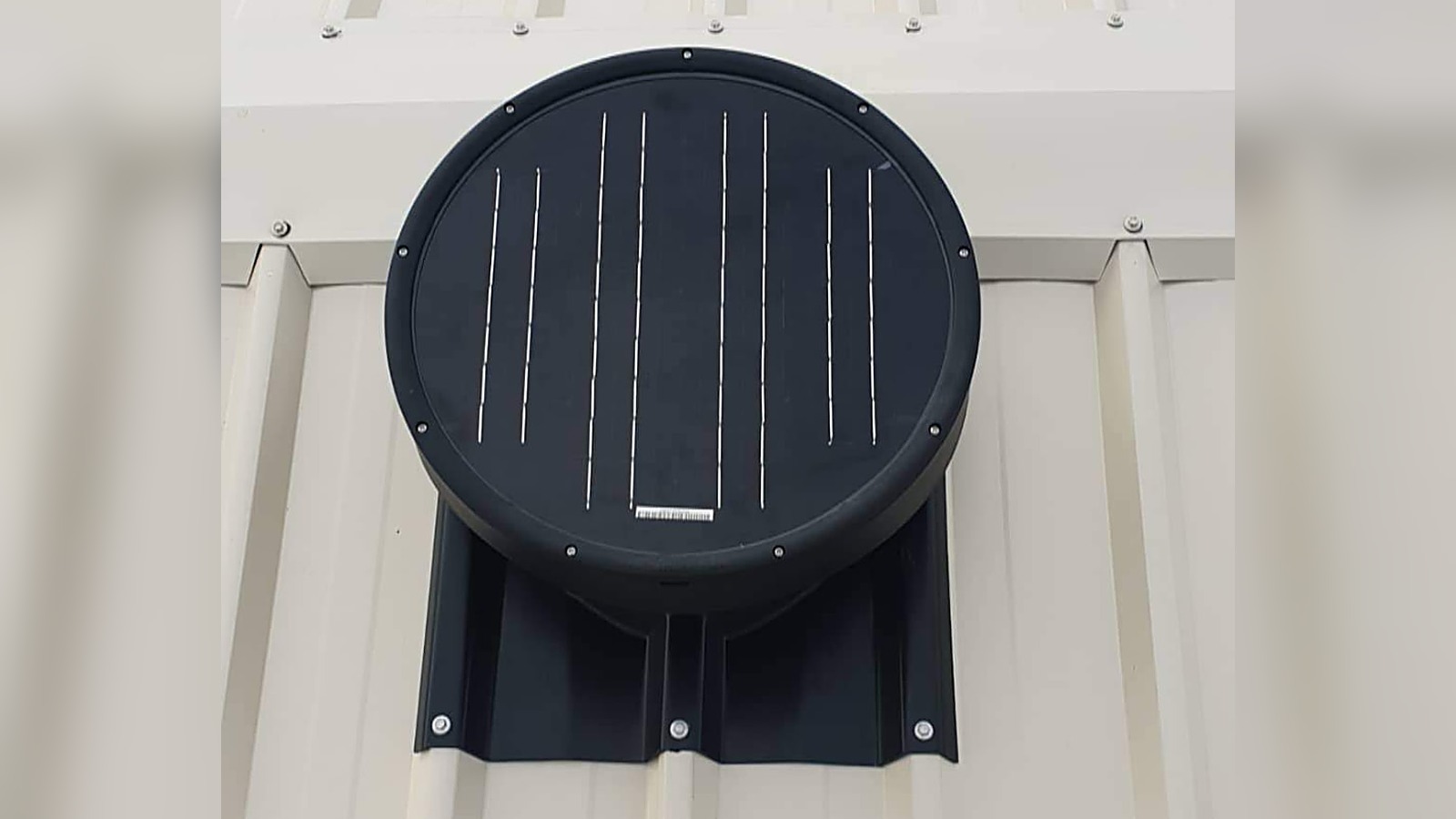
Solar-powered roof ventilator with charcoal flashing fitted to a cream COLORBOND steel shed roof by Spartan Sheds in Bundaberg QLD

Roof ventilationget the hot air out

Hot air rises and then sits under the roof of your shed with nowhere to go. Roof ventilators give it an exit. We fit MaxBreeze® solar-powered ventilators and Spinaway® wind-driven ventilators by Ampelite Australia, and we work out how many the building needs rather than putting one on and hoping.

  • MaxBreezeSolar-powered roof ventilators
  • Ampelite AustraliaSpinaway® wind-driven roof ventilators

Wind-driven vs solar-powered

A wind-driven ventilator — a whirlybird — spins on the breeze and draws warm air out of the roof space. It has no running cost, nothing to wire and nothing to fail electrically. On a breezy coastal site it does a genuinely useful job.

A solar-powered ventilator runs a fan off its own panel, so it works hardest exactly when you need it: a still, blazing hot afternoon with no breeze at all. That is the day a whirlybird sits motionless. For workshops that get used through summer, solar units are usually the better answer.

  • Spinaway® wind-driven: no power, no running cost, works with the breeze
  • MaxBreeze® solar: powered extraction on still, hot days
  • Both can be combined across a larger roof
  • Ventilator count is set by the floor area and roof pitch, not by guesswork

Air has to get in as well as out

A ventilator can only exhaust as much air as the building lets in. If the shed is sealed tight, the ventilator starves and you get very little movement. Low-level intake — wall vents, louvres, an open window, or gaps designed into the build — is what makes the ridge extraction actually work.

We plan intake and exhaust together, which is why ventilation, windows and door positions get discussed in the same conversation.

Why Ampelite and MaxBreeze

Ampelite Australia manufactures the Spinaway® range and is a long-established Australian supplier of roofing and ventilation products, so replacement parts and support exist locally. MaxBreeze solar units give us a powered option that does not need an electrician or a circuit run to the roof.

Both are specified and flashed into the roof as part of the build, so the penetration is detailed properly rather than cut in afterwards and sealed with hope.

Roof ventilation — questions we get asked

How many whirlybirds does a shed need?
It depends on the floor area, the roof pitch and how the shed is used. One unit on a large machinery shed will not do much. We work the number out with your design rather than fitting a default.
Are solar roof ventilators better than whirlybirds?
On still, hot days, yes — a solar unit keeps extracting when a wind-driven one has stopped. Wind-driven units cost less and have nothing to power. Many sheds end up with a mix.
Do I still need insulation if I have roof ventilators?
They do different jobs. Insulation slows heat getting in; ventilation removes heat already inside. For a workshop used through a Bundaberg summer, you want both.
Read more: Keeping a shed cool in Bundaberg

Genuine Australian steel

Every Spartan Shed is built from 100% Australian BlueScope® steel with genuine COLORBOND®, COLORBOND® Ultra or ZINCALUME® finishes - backed by BlueScope® steel warranties and our own workmanship guarantee. Ask us for full warranty details on your specific building. More on the steel we build from.

  • BlueScope® Australian steel — used by Spartan Sheds, shed builders in Bundaberg QLD
  • COLORBOND® steel logo — COLORBOND® sheds, garages and carports across Bundaberg and the Wide Bay
  • ZINCALUME® steel logo — ZINCALUME® roofing and cladding supplied by Spartan Sheds Bundaberg

Add roof ventilation to your quote

Tell us what the shed is for and we will specify the options that suit it, priced as part of the build rather than bolted on later. Every Spartan Sheds™ building is engineered for your site in 100% Australian BlueScope® steel.